Sinopsis
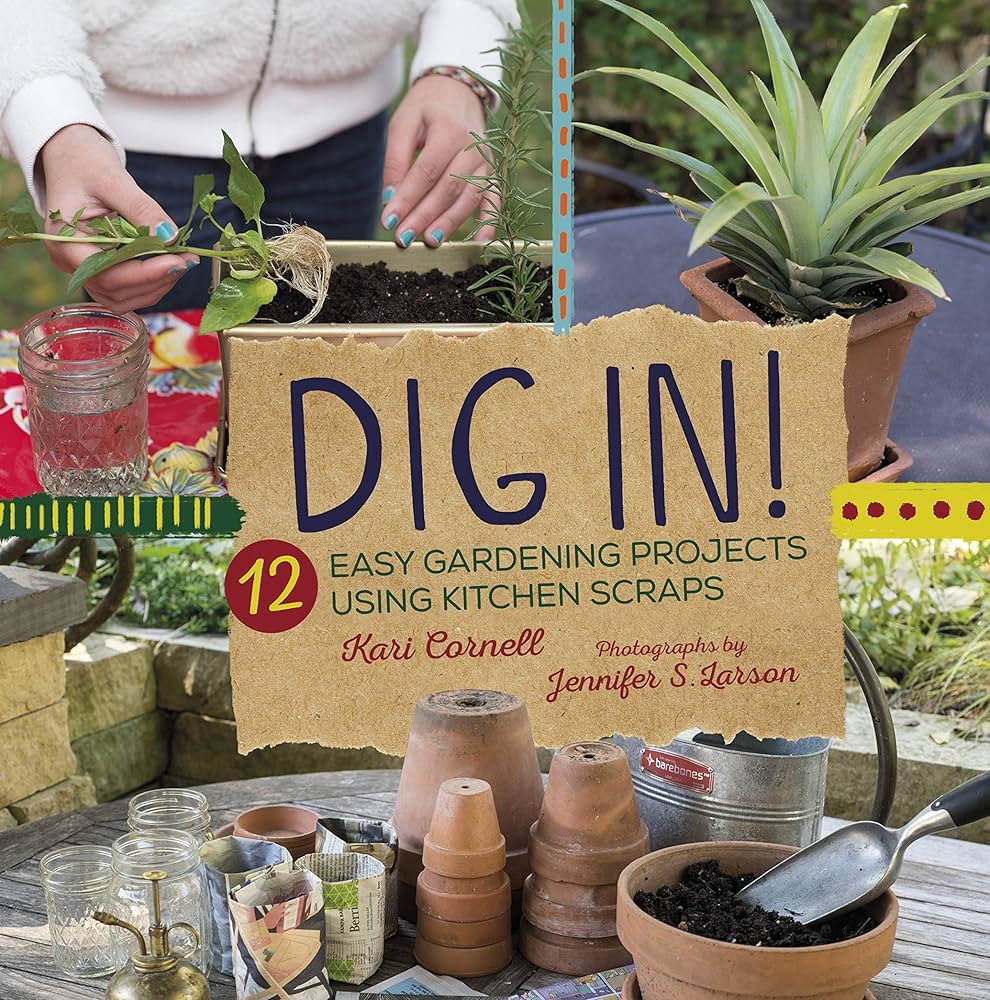
"DIG IN!: 12 Easy Gardening Projects Using Kitchen Scraps" by Kari A. Cornell offers a practical, hands-on guide for children, families, and beginners in gardening to embark on a sustainable journey of growing their own plants from the remnants of their kitchen waste. This engaging book bridges the gap between sustainability and gardening, encouraging readers to look at their kitchen scraps not a: waste, but as the beginnings of new
| Nombor Buku | 635 |
|---|
| Tempat Terbitan | Minneapolis, MN |
|---|
| Penerbit | Millbrook Press |
|---|
| Ukuran Tinggi Buku | 9781728477848 |
|---|
Sasaran Biblioterapi
| Bil |
Sasaran |
Bukti Isi Buku |
| 1 |
Children and Preteens (Ages 9–14 / Grades 4–8) |
Literary logs explicitly list the intended audience as a "juvenile audience" spanning ages 9 to 14. |
| 2 |
Parents, educators, or beginners |
The book utilizes simple step-by-step illustrations and calls for minimal equipment, stating that several projects require "nothing more than a jar, a windowsill, and a few pieces of food that would otherwise end up in the trash". This makes it perfectly tailored to young learners operating within a home environment. |
Perkembangan Diri
| Bil |
Perkembangan |
Bukti Isi Buku |
| 1 |
Cultivating Patience & Long-Term Commitment |
Personal growth requires moving away from instant gratification. The book actively fosters this by explicitly prompting readers to track subtle changes over time. Reviewers note that the text "encourages patience; many projects require several weeks of monitoring." |
| 2 |
Developing Problem-Solving and Autonomy |
The structure teaches young readers how to follow systematic instructions to achieve a tangible, productive outcome. For example, the chapters walk through distinct scientific techniques, such as growing "romaine lettuce leaves from stubs" or "starting herbs from cuttings," giving the reader a practical sense of agency over their food. |
| 3 |
Resourcefulness and Environmental Awareness |
The central premise forces a developmental shift in perspective regarding waste. Instead of viewing an old sweet potato or celery base as garbage, the child learns to recognize its ongoing "regenerative power," turning a passive kitchen leftover into a functioning, edible asset. |